REFERENCE
- Gallery page: https://magpui.com/en/i/red-clock-portfolio-you-can-play-f26224
- First frame (image): https://dnioievkvxejjbxgwvko.supabase.co/storage/v1/object/public/media/red-clock-portfolio-you-can-play-f26224/shot.jpg
- Clip (mp4): https://dnioievkvxejjbxgwvko.supabase.co/storage/v1/object/public/media/red-clock-portfolio-you-can-play-f26224/clip.mp4
- Original post: https://x.com/OnePageLove/status/2118366226233561250 by Arthur Petrillo
Before building, download the first frame and look at it. If ffmpeg is available, download the clip and extract frames (ffmpeg -i clip.mp4 -vf fps=2 frame-%02d.png), then study the motion frame by frame. Match what you see; the text below describes it, the frames are the truth.

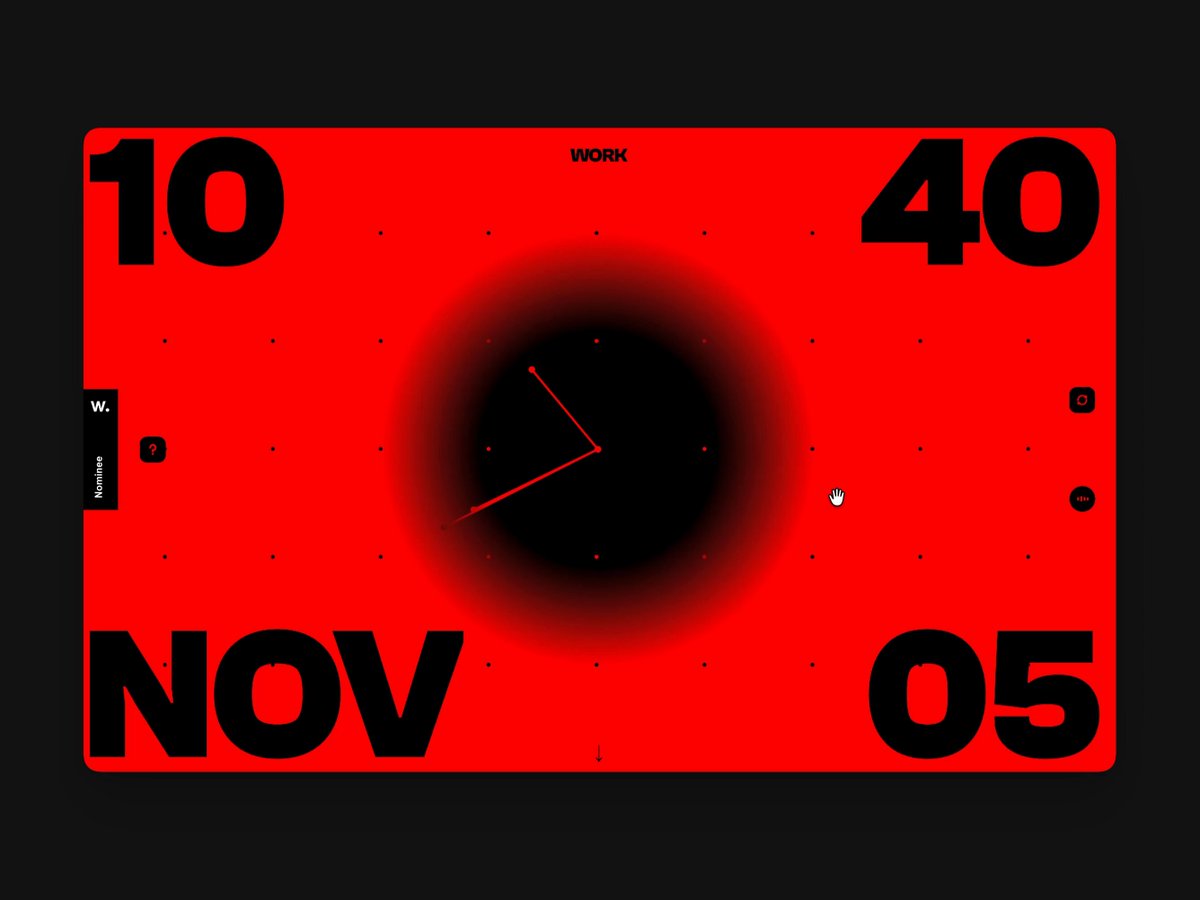
BUILD: A one-page experimental design-studio portfolio that feels like a playable instrument. The hero is a full-viewport, rounded red panel showing the current date and time as four giant black numerals and words in the corners (hour top-left, minutes top-right, month bottom-left, day bottom-right). In the center sits a large clock dial rendered as a soft black radial void that fades into the red, with two thin red hands. The hands are draggable: pull a hand off the dial and it stretches like a rubber band, its tip snaps to the nearest dot of a faint 9x5 dot grid, and each snap draws a straight red segment, so the user can sketch polylines and triangles across the page; letting go springs the hand back to real time. Every grab, snap and release plays a short percussive tick. Below the hero, a dark 'Work' area shows a single 3D half-and-half sphere (top and bottom hemispheres in different materials: gold-and-black marble, chrome spikes, coral rubber, violet glass, knit fabric) that swaps material when you click either half or pick a swatch from a top toolbar. Feel: severe, loud, witty, tactile.

DESIGN SYSTEM: Page background #111111; hero panel inset 4vw with 16px radius, fill #FF0000. Numerals and words: an ultra-wide heavy grotesk, black #000000, about 14vw tall, tight letter-spacing (-0.04em), hugging the panel corners with 1-2vw padding. Small centered section label at top ('WORK') in 14px heavy uppercase. Dot grid: 3px black dots at 50% on a 9x5 grid across the panel. Dial: radial-gradient(circle, #000 0 38%, rgba(0,0,0,0) 62%), diameter about 34vw. Hands: 2px red #FF1A1A lines with 6px round tips; the hour hand 40% shorter. Side UI: a black vertical tab on the left edge (award badge), small 28px square black icon buttons on the right (sound toggle, reset, menu) and a '?' help button at left. Work area: #000 background, top toolbar with HOME / WORK labels, a row of 32px rounded material swatches (red, mustard, sage...) and two round social buttons; a 6px green progress bar along the bottom edge.

MOTION: Clock: second hand logic hidden, hour and minute hands ease to real time with a 400ms cubic-bezier(0.34, 1.56, 0.64, 1) on load. Drag: the hand tip follows the pointer with a spring (stiffness 300, damping 22); within 24px of a grid dot it snaps over 120ms and a segment is committed from the previous anchor; segments fade out after 6s. Release: the hand returns to its time angle with an overshoot spring over 700ms, cubic-bezier(0.34, 1.56, 0.64, 1). Cursor: open-hand cursor over the dial, closed hand while dragging. The black void breathes subtly (scale 1 to 1.03 over 4s, ease-in-out). Work sphere: idle slow Y rotation 8 degrees per second; clicking a hemisphere cross-fades its material over 500ms with a quick 0.94 squash and spring back; hover lifts the half by 4px.

SECTIONS: 1) Hero clock panel as described, with an arrow-down hint at the bottom center. 2) Work: material-swap sphere and toolbar, plus a project list that reveals as you scroll. 3) Timeline of past roles and years in large type. 4) Biography paragraph in big black-on-red text. 5) Clients as a typographic list. 6) Footer with contact links and the live clock repeated small.

IMPLEMENTATION: Hero in SVG plus Pointer Events (hands, grid and segments are SVG lines, the void is a CSS radial gradient), physics with a tiny spring integrator in requestAnimationFrame. Sound with the Web Audio API: short synthesized clicks (oscillator plus noise burst, 40-80ms) with a mute toggle that defaults to muted until the first interaction. Work sphere in Three.js: two hemisphere meshes with MeshPhysicalMaterial presets (clearcoat marble, metal with displaced spikes, transmission glass, knit normal map) and an HDR environment. Keyboard: hands focusable, arrow keys rotate them, Enter snaps to the nearest dot; Escape resets. prefers-reduced-motion: no springs or breathing, hands jump to positions, sphere static. Keep the numerals as real text for accessibility.

ADAPT TO THE PROJECT: Reuse the project's fonts, tokens and components; map the red and black to the closest existing tokens. Never copy the original logo, name, award badge, project images or copy: use placeholders and your own studio name.

SUCCESS CHECK:
- The corner numerals always show the real current date and time and update every minute.
- Dragging a hand off the dial snaps its tip to grid dots, draws red segments and springs back on release, with a tick sound when sound is on.
- Clicking either half of the work sphere swaps only that hemisphere's material with a short squash.