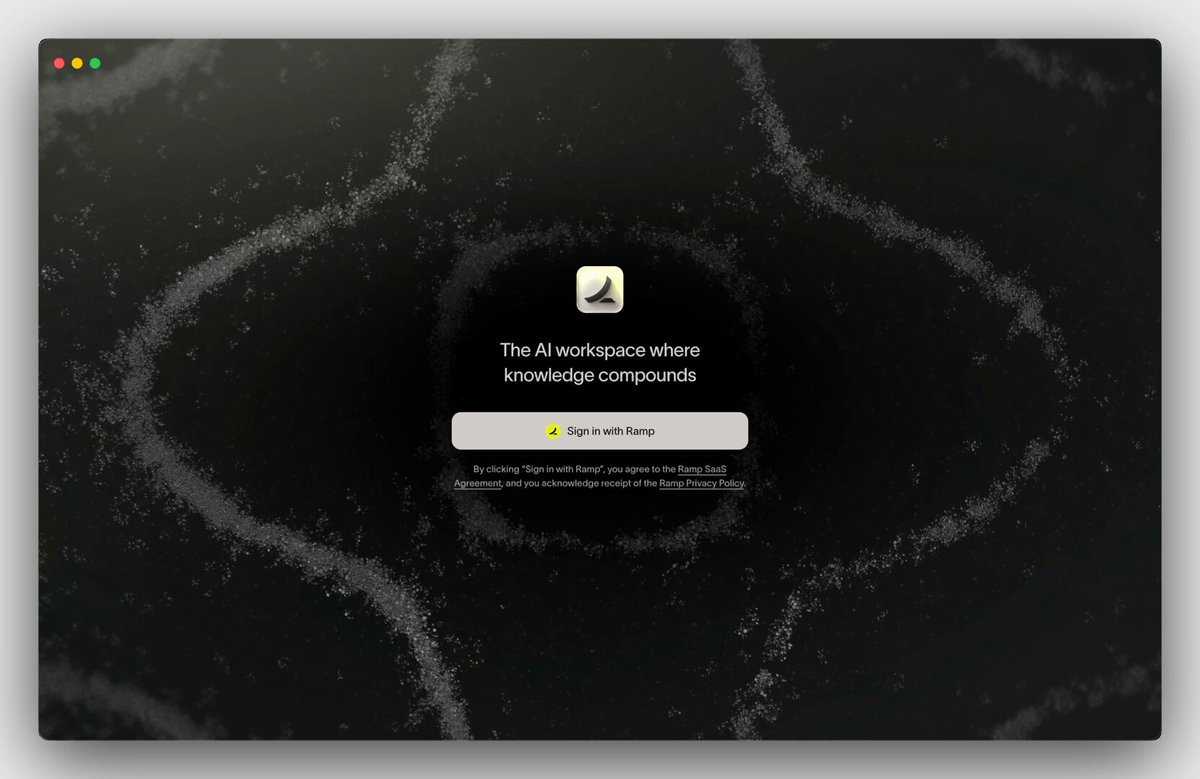
REFERENCE
- Gallery page: https://magpui.com/en/i/sign-in-over-cymatic-sand-field-860ab9
- First frame (image): https://dnioievkvxejjbxgwvko.supabase.co/storage/v1/object/public/media/sign-in-over-cymatic-sand-field-860ab9/shot.jpg
- Clip (mp4): https://dnioievkvxejjbxgwvko.supabase.co/storage/v1/object/public/media/sign-in-over-cymatic-sand-field-860ab9/clip.mp4
- Original post: https://x.com/pontusab/status/2119865335990141433 by @pontusab
Before building, download the first frame and look at it. If ffmpeg is available, download the clip and extract frames (ffmpeg -i clip.mp4 -vf fps=2 frame-%02d.png), then study the motion frame by frame. Match what you see; the text below describes it, the frames are the truth.

BUILD: A full-screen sign-in screen on a dark background where thousands of fine sand-like particles form symmetric standing-wave patterns (Chladni or cymatics figures). The pattern slowly morphs: it starts as a few large soft loops around the center and continuously reorganizes into denser and denser lattices of rounded cells, then relaxes back. In front, a small centered sign-in block: app icon, a two-line headline, one pill sign-in button and a tiny legal line. A dark radial vignette behind the form keeps it readable. It should feel calm, scientific and alive, like sound made visible.

DESIGN SYSTEM: Background #0B0B0B with a faint warm noise. Particles: 1 to 1.5 px dots, color #D9D6CF at 35-70% opacity, clustering on the nodal lines so lines look like soft dusty strokes 6-14 px wide with scattered grains in between. Center vignette: radial gradient from #000000 at 80% to transparent, radius about 320 px, so the pattern fades out behind the form. Form stack centered, width about 320 px: icon tile 40 px with radius 10 px and a light cream fill; headline 18-20 px medium sans serif, white #F5F5F5, two lines, centered, line-height 1.25; button full width 320x36 px, radius 8 px, fill #EDEDED, label 13 px dark #111 with a small leading icon; legal text 10-11 px #8A8A8A, centered, with underlined links. Spacing: 16 px icon to headline, 20 px headline to button, 14 px button to legal.

MOTION: Pattern morph: interpolate the standing-wave equation between modes (for example cos(n*pi*x)cos(m*pi*y) - cos(m*pi*x)cos(n*pi*y) with n and m stepping from 1,2 up to about 5,8), one mode change every 2.5-3 s, cross-fade of the target field over 1800 ms with cubic-bezier(0.45, 0, 0.55, 1). Particles move toward the nearest nodal line (where the field is near zero) with damping, plus small random jitter (0.3 px per frame) so the sand looks like it is vibrating. Intro: on load, particles start scattered and gather into the first pattern in 1200 ms, while the form fades and lifts 8 px in 500 ms, cubic-bezier(0.22, 1, 0.36, 1), delay 300 ms. Button hover: background to #FFFFFF in 150 ms.

SECTIONS: Background layer: particle field plus vignette. Form: icon, headline, sign-in button (idle, hover, pressed with 0.98 scale, loading with a small spinner replacing the icon), legal line.

IMPLEMENTATION: Use WebGL (Three.js points or OGL) or a GPU particle simulation: store particle positions in a float texture, update them in a fragment shader by moving along the negative gradient of the absolute field value, and render as additive points. 60k to 120k particles on desktop, 20k on mobile; pause the simulation when the tab is hidden. Canvas 2D is acceptable for about 15k particles as a fallback. prefers-reduced-motion: render one static pattern and stop the morph. The form is regular HTML on top with full keyboard focus states; the canvas is aria-hidden.

ADAPT TO THE PROJECT: Reuse the project's existing design tokens, auth components and fonts; map colors to the closest existing neutral tokens. Do not copy logos, brand names, photos or illustrations from the original; use a placeholder icon and headline.

SUCCESS CHECK:
- The background shows symmetric sand patterns that visibly reorganize into a new figure every few seconds without popping.
- The form stays readable thanks to the center vignette and works fully with the keyboard.
- With prefers-reduced-motion on, a single still pattern is shown and nothing animates.