REFERENCE
- Gallery page: https://magpui.com/en/i/context-window-bar-that-compacts-1ce12f
- First frame (image): https://dnioievkvxejjbxgwvko.supabase.co/storage/v1/object/public/media/context-window-bar-that-compacts-1ce12f/shot.jpg
- Clip (mp4): https://dnioievkvxejjbxgwvko.supabase.co/storage/v1/object/public/media/context-window-bar-that-compacts-1ce12f/clip.mp4
- Original post: https://x.com/shedsgns/status/2116032350442111282 by @shedsgns
Before building, download the first frame and look at it. If ffmpeg is available, download the clip and extract frames (ffmpeg -i clip.mp4 -vf fps=2 frame-%02d.png), then study the motion frame by frame. Match what you see; the text below describes it, the frames are the truth.

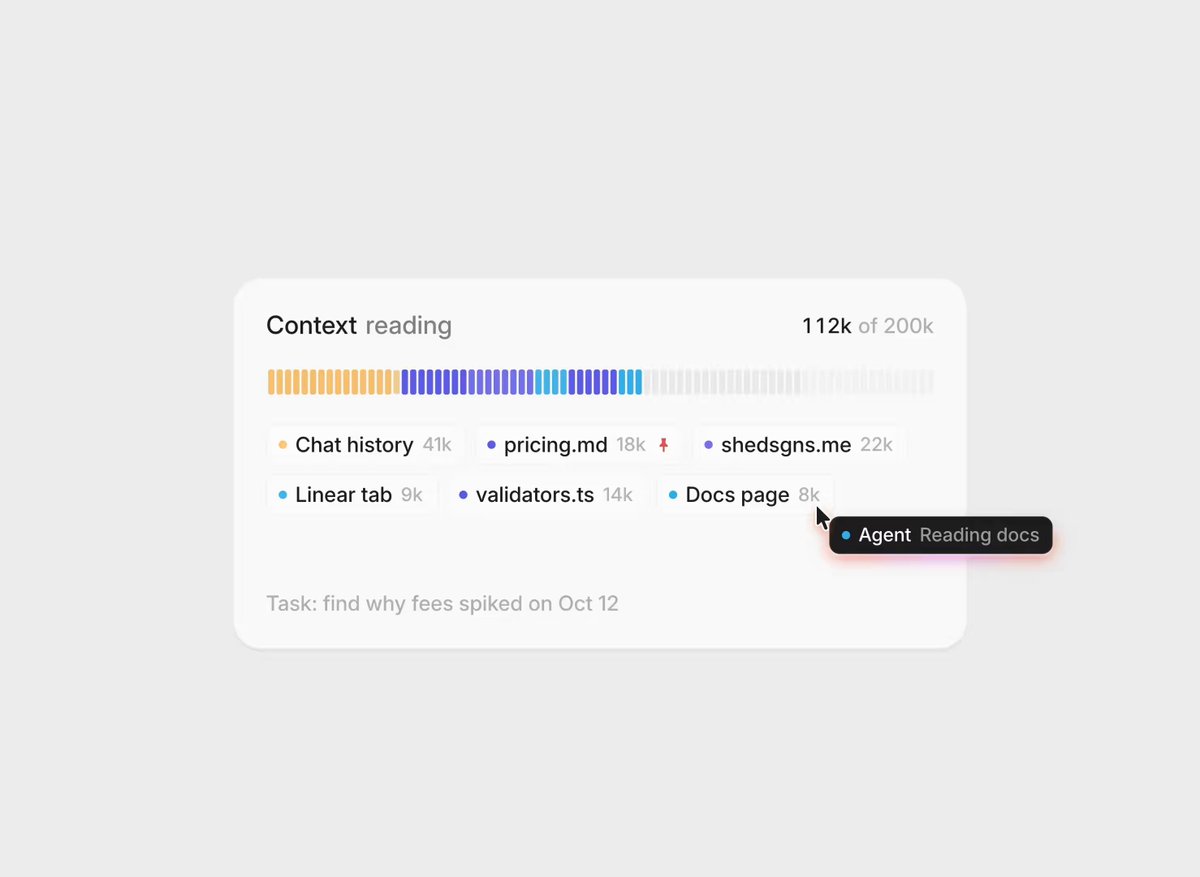
BUILD: A compact card that visualizes how an AI agent fills and manages its context window. A horizontal bar made of thin vertical ticks fills up as the agent reads sources; each source appears as a small labelled chip below with its token size. A floating agent cursor with a dark label narrates what it is doing (Reading docs, Reading the audit log, Compacting, Found the cause). Near the limit the oldest chunk (chat history) visibly squeezes into a much smaller summary chunk, freeing space, then reading continues until a result line appears. It should feel calm, precise and explanatory, like a good developer tool demo.

DESIGN SYSTEM: Card about 420px wide, background #FAFAFA on a page of #EFEFEF, radius 12px, 1px border #E6E6E6, very soft shadow 0 1px 3px rgba(0,0,0,0.04), padding 16px. Header row: 'Context' in a neutral sans 13px/600 #111111 followed by a state word (reading / compacting) 13px #9A9A9A; at right a counter like '112k of 200k' with the number 12px/600 #111111 tabular and 'of 200k' #A0A0A0. Bar: full width, 12px tall, made of 2px ticks with 1px gaps, empty track #ECECEC; each source has its own color (chat history amber #F2B66D, files purple #6C5CE7 / #8B7CF6, logs blue #5B8DEF, web pages cyan #4FC3E8, summary gray #B8B8B8). Source chips below in a wrapping row, gap 6px 14px: 6px dot in the source color, name 11px #333333, size 11px #A8A8A8 (for example 'pricing.md 18k'); a chip can carry a tiny red up-arrow marker for a hot file. Footer caption 11px #A0A0A0 (Task: find why fees spiked on Oct 12), replaced by a result line 12px/500 #111111 at the end. Agent cursor: a black arrow pointer plus a pill label, bg #111111, text 11px white, radius 6px, padding 3px 8px, a 4px pink/red #FF4D6D underline glow under the pill.

MOTION: Reading: ticks for the new source fill left to right at about 60 ticks per second, linear, while the counter rolls up with tabular digits over the same duration. New source chip enters with opacity 0 to 1 and translateY 4px to 0, 220ms, cubic-bezier(0.22,1,0.36,1). The cursor glides to the chip being read, 450ms, cubic-bezier(0.65,0,0.35,1), and its label text cross-fades 150ms. Compacting: header state word changes to 'compacting', the chat-history chip gets a 1px border highlight, its segment in the bar shrinks from about 41k to 4k width over 700ms cubic-bezier(0.83,0,0.17,1) while all following segments slide left to close the gap, the counter rolls down, and the chip label morphs from 'Chat history' to 'Chat summary' with a quick blur-and-fade 200ms. Found: the matching chip gets a white raised outline, the caption swaps to the result sentence with a 240ms fade-up.

SECTIONS: Header (title, state, token counter); tick bar; source chip grid; caption or result line; floating agent cursor. States: idle, reading (loop through sources), compacting, found. Drive it with a small scripted timeline of steps so it can autoplay and loop, plus optional manual step buttons.

IMPLEMENTATION: React with Motion (layout animations for segment widths and chip reflow, AnimatePresence for chip enter and label swaps). Render the bar as flex segments whose width is tokens / limit, with a repeating-linear-gradient for the tick pattern so it stays cheap. Use font-variant-numeric: tabular-nums for counters. prefers-reduced-motion: jump between states without width tweens and hide the moving cursor, keep the labels. Expose the state in an aria-live polite region (for example 'Compacting older chat, 122k of 200k'). Keep it to transforms and widths on a handful of elements; no canvas needed.

ADAPT TO THE PROJECT: Reuse the project's existing design tokens, fonts, card and badge components; map the source colors to the closest existing palette tokens. Do not copy brand names, logos or the original file names; use placeholder sources and a placeholder task.

SUCCESS CHECK:
- The bar fills source by source and the counter always matches the sum of the visible segments.
- During compacting the oldest segment shrinks into a summary and the later segments slide left smoothly without jumps.
- With prefers-reduced-motion on, states change instantly and the live region announces each step.